
Work schedule errors cause payroll mistakes because the schedule is the master data that pay is calculated from. A pattern that is one day out of alignment, a rotation that does not divide cleanly into the schedule period, or an effective date that disagrees between the pattern and the assignment will all look fine in a spreadsheet. Then payroll calculates the wrong hours.
This guide explains the six most common failure modes in Oracle Cloud HCM work schedule loads, why spreadsheets do not catch them, and what a controlled process looks like.
Why do work schedules cause payroll errors?
Work schedules are one of the quiet causes of payroll errors. They sit upstream of time, absence and pay calculations, so a small fault in a pattern is repeated for every employee who is assigned to it, every pay period, until someone notices.
Most organisations start with a spreadsheet because it is familiar and flexible. The problem is that a spreadsheet does not know the rules of Oracle Cloud HCM. It will happily accept a pattern that Oracle would treat differently.
What are the most common work schedule failure modes?
| What happens | Why it causes a problem |
|---|---|
| The pattern length does not divide into the schedule period | The final week is incomplete or duplicated, and hours are wrong |
| The rotation start day does not match the assignment start date | Every shift after the first is offset by a day |
| Effective dates differ between the pattern, the assignment and the payroll period | The schedule is active when it should not be, or inactive when it should be |
| The same pattern is recreated with small variations | The pattern library becomes inconsistent and impossible to audit |
| Errors are found after the load | Corrections are manual, and payroll may already have run |
| The process depends on one person | Holidays, leavers and busy periods create operational risk |
These are not rare edge cases. They are the normal failure modes of managing complex schedules in a tool that was designed for data entry, not validation.
Who is most exposed to work schedule errors?
- Shift-based workforces with rotating patterns
- 24/7 operations with nights, weekends and public holidays
- Multi-site organisations with different local patterns
- Teams with high-volume schedule changes driven by demand, absence or seasonality
- HR shared service teams managing schedule requests from managers
- Payroll teams that inherit schedule errors at cut-off
If every employee works the same standard week and changes are rare, Oracle’s native schedule functionality is usually enough.
How do you prevent work schedule errors before payroll?
- Validate before you load. Check each pattern against the schedule period, the assignment dates and the expected structure, so gaps, overlaps and incomplete patterns are found while the data is still in the team’s hands.
- Reuse and correct patterns, do not rebuild them. One named pattern with a clear length and rotation is easier to audit than many near-copies.
- Load in controlled batches with a record of what was submitted. A clear submission record turns a payroll query into a quick check.
- Extend and end-date schedules deliberately. Expiring schedules should be extended in place, without moving employees, and ending schedules should be found before they end.
- Make the process repeatable. A documented process that the team owns removes the dependency on one person.
Payroll still needs its own reconciliation, but it should be reviewing exceptions at cut-off rather than cleaning master data.
How does ScheduleX help?
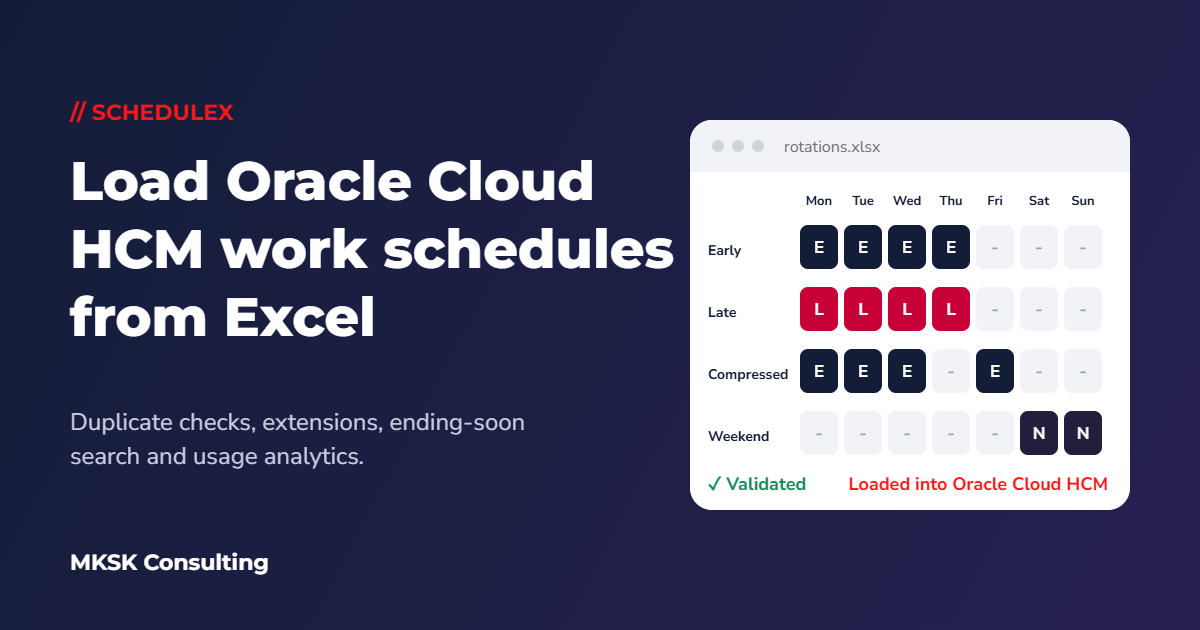
ScheduleX is MKSK’s work schedule management tool for Oracle Cloud HCM. Teams build rotations in Excel, ScheduleX validates them before anything is created, checks for duplicates, and loads the schedules into Oracle Cloud HCM. It can also extend expiring schedules, show which schedules are ending soon, and report on how your company uses work schedules.
It does not replace Oracle’s scheduling. Oracle remains the system of record. ScheduleX is the layer that makes the data feeding Oracle accurate, repeatable and auditable. It is part of the MKSK X Cloud Platform alongside FormulaX, our AI Fast Formula Generator.
If schedule data is causing payroll corrections, or your team is rebuilding the same spreadsheets every month, book a short demo and bring one complex pattern and one recent load problem. We will show you how ScheduleX would handle it. You can read the full product details on the ScheduleX page.