
// ScheduleX
Load Oracle Cloud HCM work schedules from Excel
ScheduleX is MKSK Consulting’s tool for Oracle Cloud HCM work schedules. Build rotations in Excel, validate them so no duplicates are loaded, and load hundreds of schedules in one pass. Then extend schedules, find those ending soon and see analytics on how your company uses them. No custom API needed. Previously known as Load Work Schedules.
// Watch
ScheduleX in 40 seconds
// Overview
What is ScheduleX?
Once the schedules are in, ScheduleX helps you extend work schedules, find the ones ending soon, and see analytics on how your company uses work schedules. It is built for enterprise use, with role-based access control, GDPR-ready audit logs, multi-tenant support, real-time processing that scales to millions of records, and automated rules and alerts for exceptions.
ScheduleX is the new name for the Load Work Schedules tool from MKSK Consulting.
// Use cases
What is ScheduleX used for in Oracle Cloud HCM?
Complex rotations built in Excel
Shift rotations, compressed weeks and site-specific patterns designed in a spreadsheet your workforce team already understands.
Hundreds of schedules in one load
Validated and loaded into Oracle Cloud HCM in a single pass, instead of screen-by-screen entry or hand-built HDL files.
Change a pattern without rebuilding it
Amend a rotation, re-validate and reload. Assignments keep their history and payroll picks up the new pattern from the effective date.
// Control
Validate, extend and monitor your Oracle Cloud HCM work schedules
Duplicate checks first
Schedules are validated before the load, so duplicates are not loaded into Oracle Cloud HCM.
Extend work schedules
Extend existing work schedules instead of rebuilding them from scratch.
Schedules ending soon
Spot the work schedules that are about to end, so you can act before they do.
Usage analytics
Analytics on how your company uses work schedules.
// In the app
See ScheduleX in action
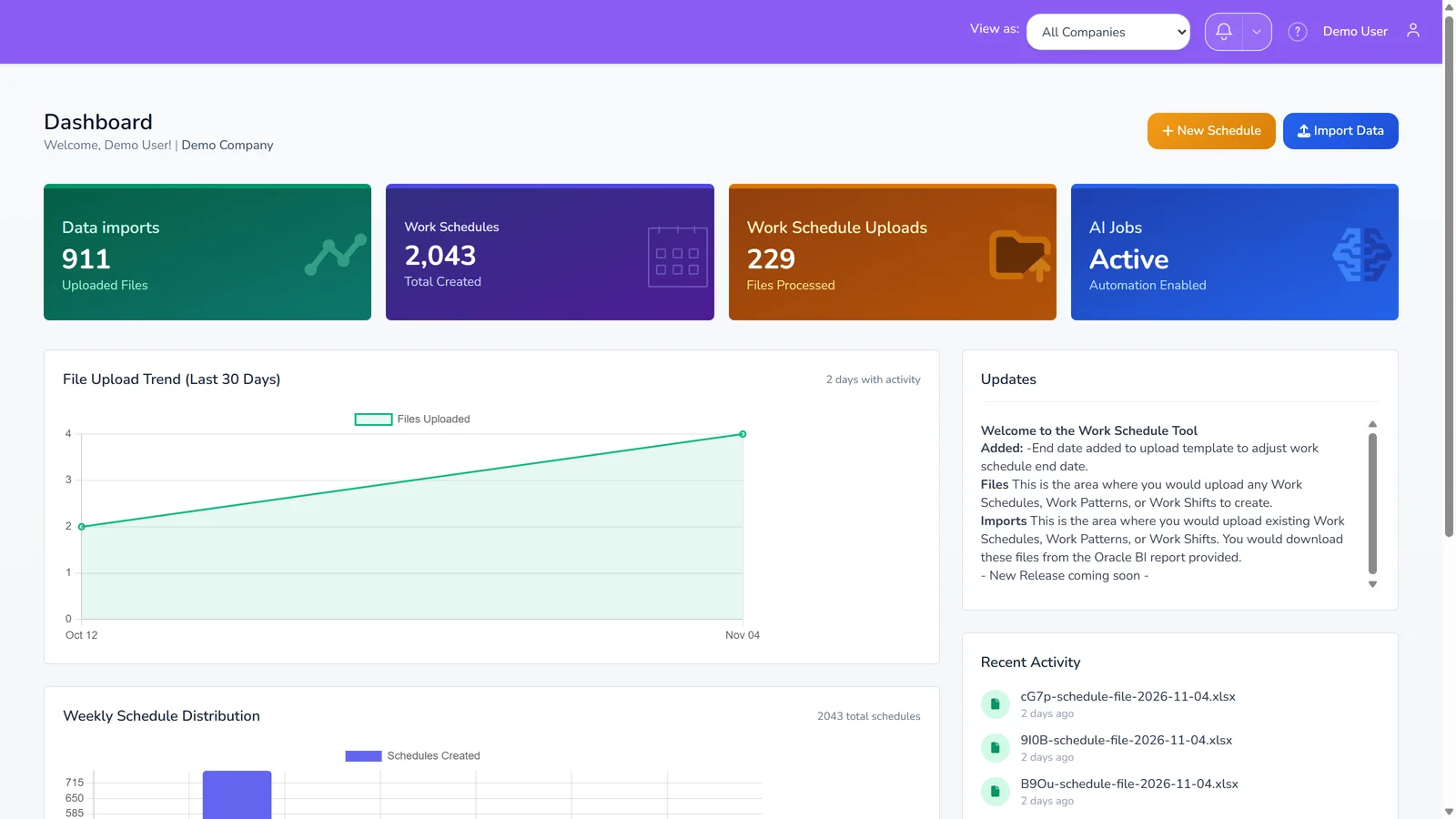
Your work schedule dashboard
See schedules created, files processed and AI jobs at a glance, with recent activity and what is new.
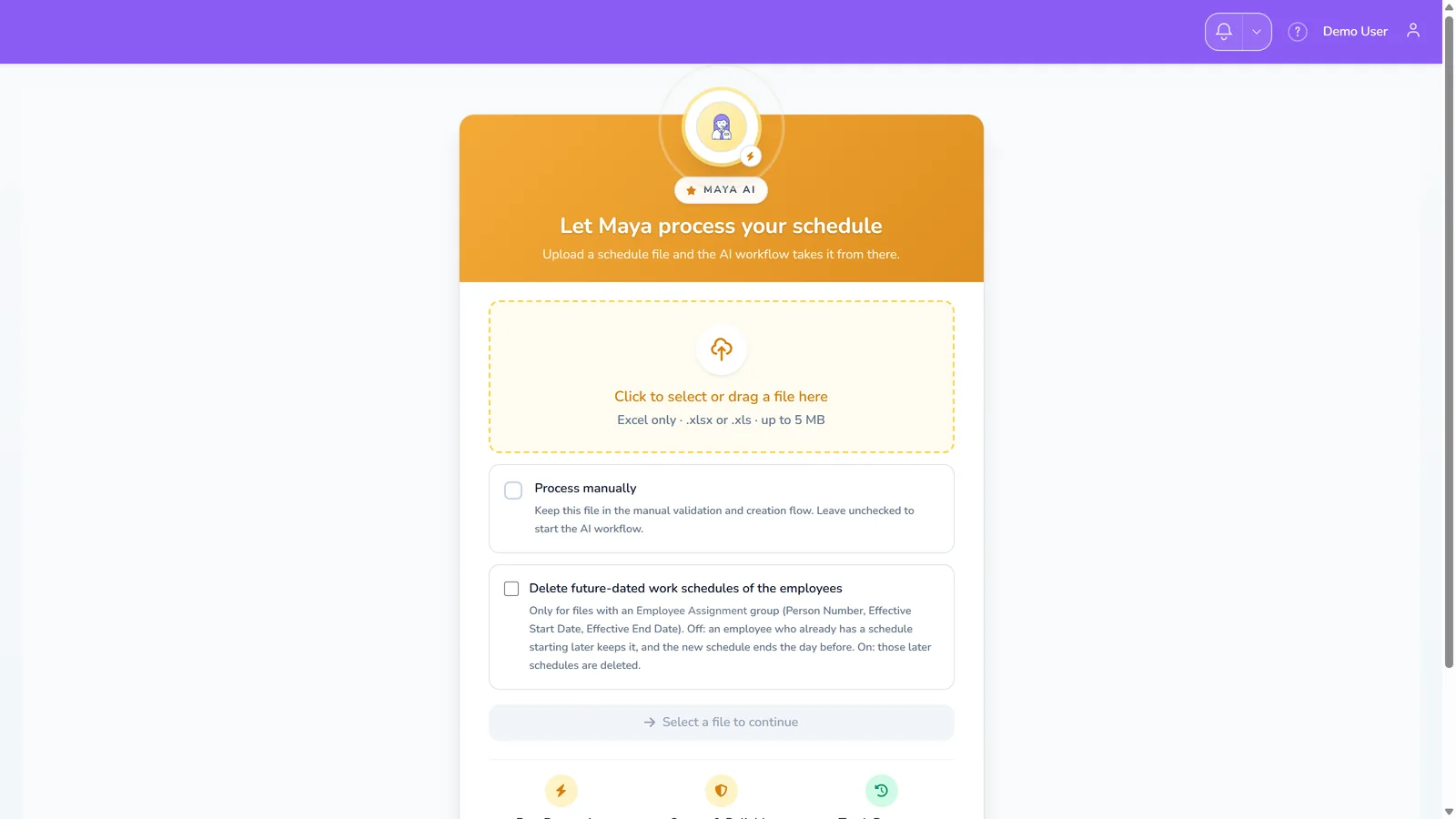
Maya AI processes your file
Upload an Excel file and the AI workflow validates and creates the schedules. Prefer to review each step yourself? Choose manual processing.
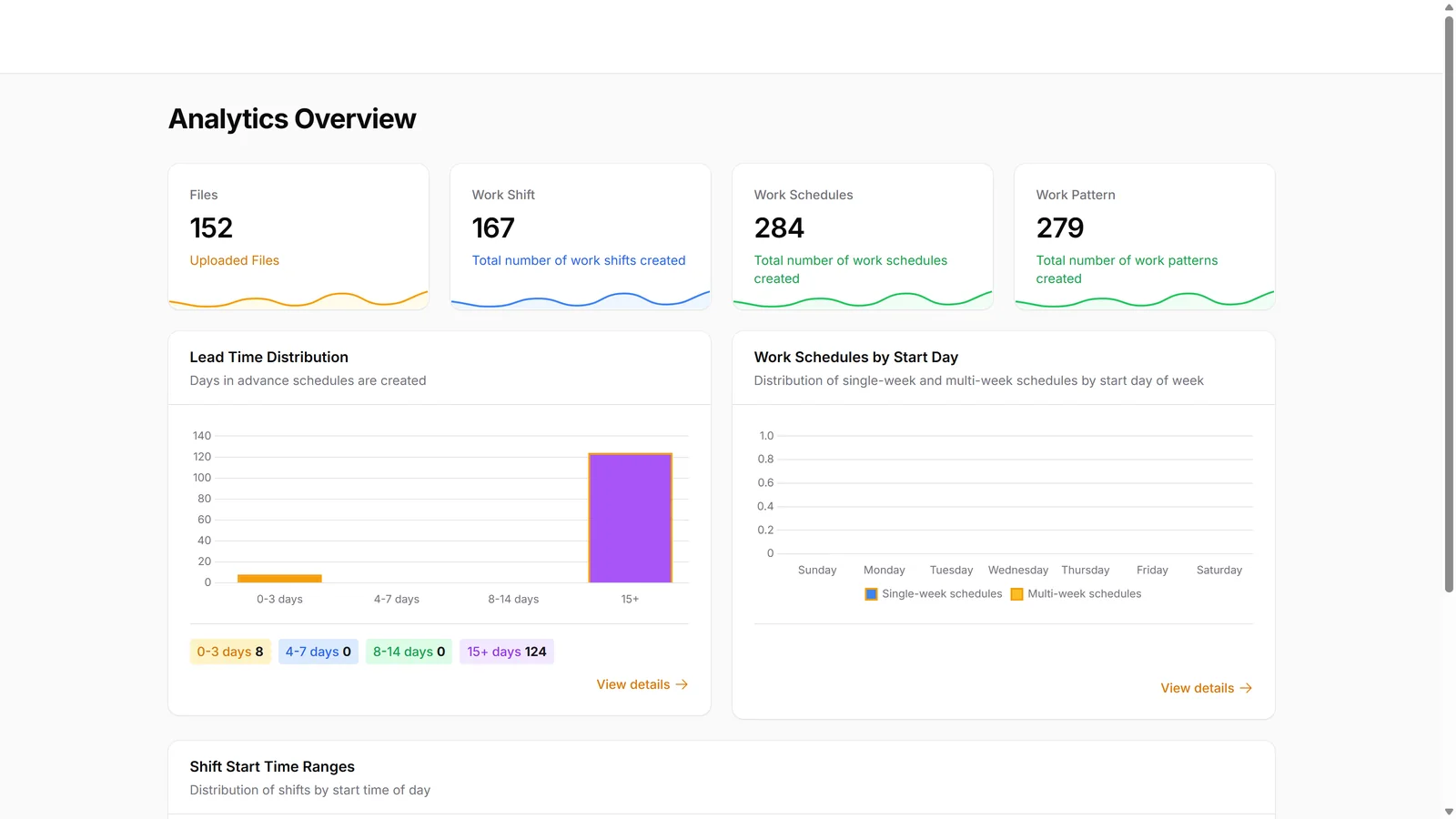
Usage analytics
See how your company uses work schedules: files, shifts, patterns, lead times and start days.
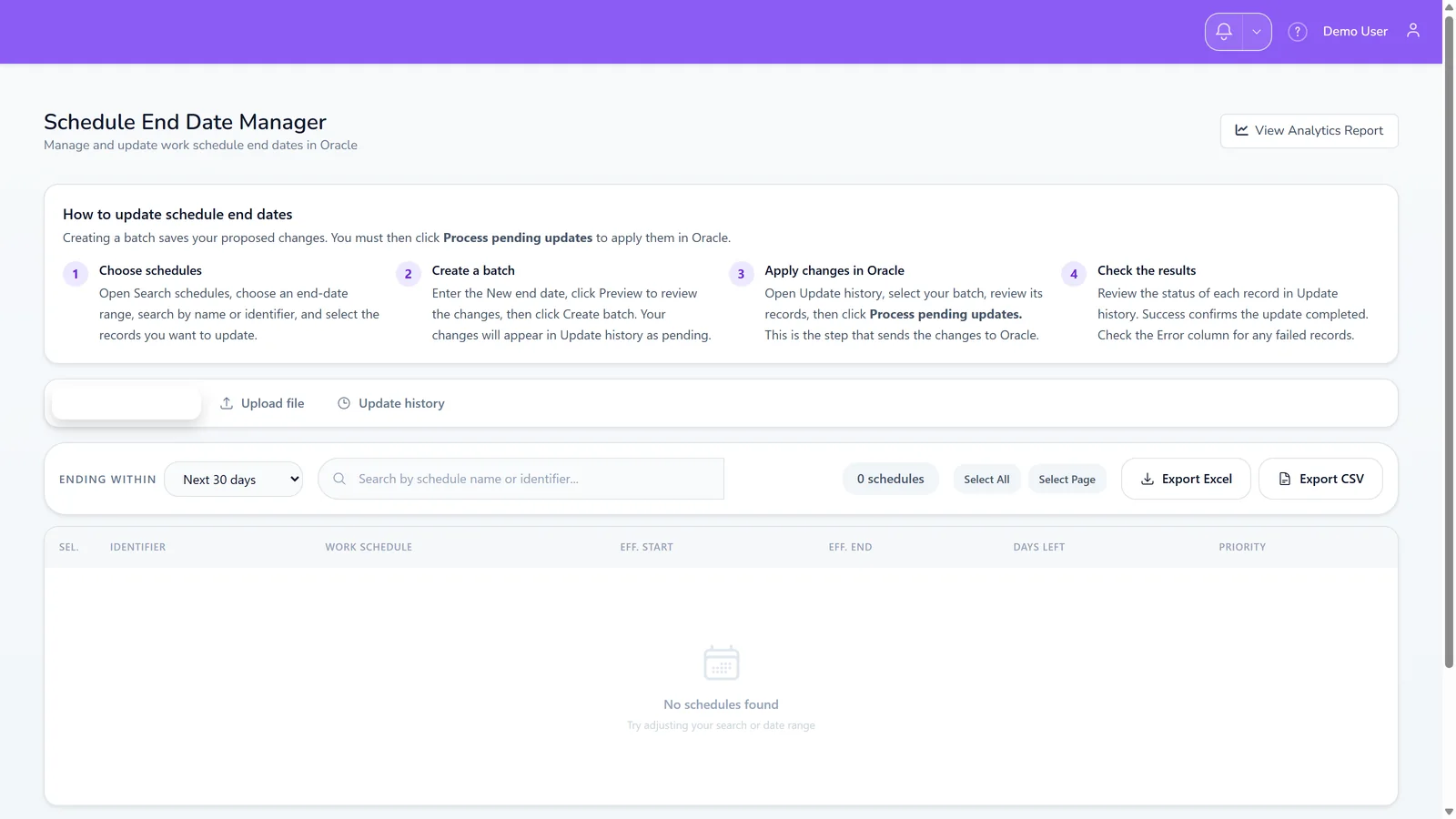
Find schedules ending soon
Filter schedules ending within the next 30 days, preview the new end date and send the batch to Oracle.
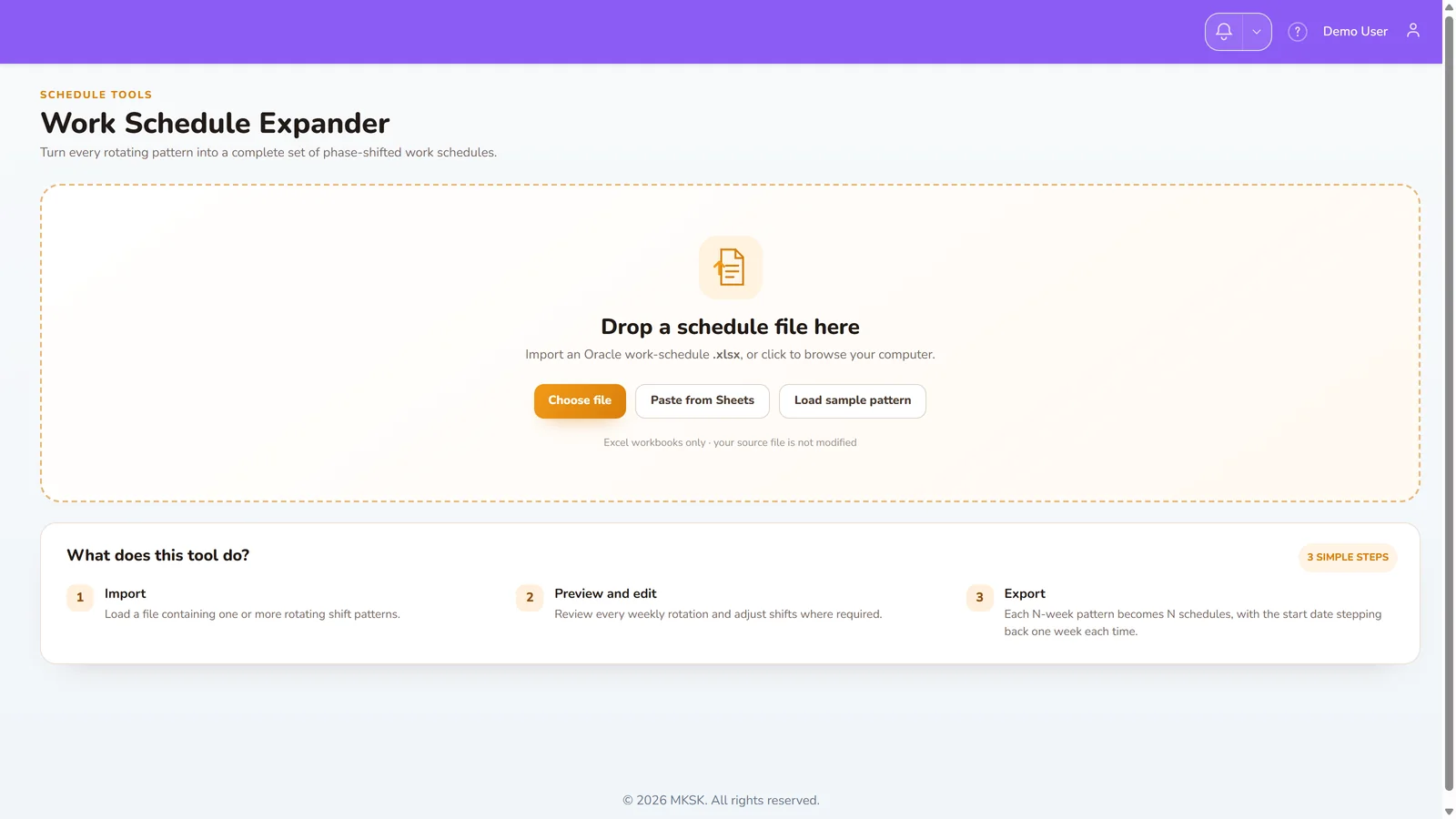
Work Schedule Expander
Import a rotating pattern, review each weekly rotation and export a complete set of phase-shifted schedules. Your source file is not modified.
More in the ScheduleX workbench
Oracle Sync. Bring in existing work schedules, patterns and shifts from Oracle, with active and archived file history.
Templates. Download approved Excel templates for single-week and rotating work schedules.
Schedule Cleanup. Find work schedules with no assignments and remove them from Oracle. Each one is re-validated before deletion.
Worker Schedule. Check which work schedule an employee is assigned to, today or on a specific date, or see their full history.
// Enterprise ready
Built for scale, control and compliance
Role-based access control
Control who can do what in ScheduleX with role-based access control (RBAC).
Audit logs, GDPR-ready
Complete audit logs and compliance built in, and GDPR-ready.
Multi-tenant support
Built-in, secure tenant isolation for multi-tenant use.
Scales to millions
Built to scale to millions of records.
Real-time processing
Schedules are processed in real time.
Exception alerts
Automated rules and alerts flag exceptions, instead of relying on manual checks.
High return on investment
A high return on investment and low operational cost.
// The problem
What problems does ScheduleX solve?
Oracle's seeded tool hits limits
The seeded Oracle Work Schedule tool struggles with large volumes and complex patterns, often crashing or supporting only a limited number of patterns. ScheduleX removes those restrictions.
Setting up schedules is slow
Setting up schedules through the Oracle UI is tedious and diverts focus from strategic HR work. The Excel-based approach simplifies the process.
No custom API to build
Building custom APIs for schedule uploads needs extra resources and adds complexity. ScheduleX is a streamlined alternative with no complex integration.
// Who it is for
Who is ScheduleX for?
ScheduleX is designed for organisations where work schedules are not a simple Monday-to-Friday, 9-to-5 default. It is less useful if every employee works the same standard week and changes are rare. In that case, Oracle’s native schedule functionality is usually enough. Not sure where errors come from? Read why work schedule errors cause payroll mistakes.
Rotating shifts
Shift-based workforces on rotating patterns.
24/7 operations
Nights, weekends and public holidays.
Multi-site organisations
Different local patterns at each site.
High-volume changes
Schedule changes driven by demand, absence or seasonality.
HR shared services
Teams managing schedule requests from managers.
Payroll teams
Teams that inherit schedule errors at cut-off.
// Compare
How does ScheduleX compare with the alternatives?
| ScheduleX | Oracle seeded tool | Custom API | |
|---|---|---|---|
| Loading schedules | |||
| How schedules are entered | An Excel spreadsheet | Through the Oracle UI | Code you build and maintain |
| Large volumes | Hundreds of schedules in one load | Struggles with large volumes | Depends on what you build |
| Complex patterns | Unlimited patterns, including rotating schedules | Limited number of patterns | Complex logic to code |
| Integration effort | None needed | Native to Oracle | Extra resources and complexity |
| Duplicate checks | Validated before the load, so duplicates are not loaded | Basic validation only | Custom logic required |
| Control and compliance | |||
| Audit logs and compliance | Complete audit logs, GDPR-ready | Oracle audit only | Requires development effort |
| Access control | Role-based access control (RBAC) | Oracle user sync only | Must build a user roles module |
| Multi-tenant support | Built-in, secure tenant isolation | Single tenant per instance | Requires multi-instance architecture |
| Exception handling | Automated rules and alerts | Basic error prompts only | Must custom-build workflows |
| Scale, speed and cost | |||
| Scale | Scales to millions of records | Depends on the Oracle backend | Requires performance tuning |
| Real-time processing | Real-time | Not available | Requires heavy custom development |
| Usage analytics | Analytics on how your company uses work schedules | Static OTBI or BIP reports | Custom BI build required |
| Cost | High return on investment, low operational cost | Oracle licence cost | High initial and ongoing development cost |
// Proof
Proven in production
250,000 work schedules
In production use with a retail client running 250,000 work schedules. No client name or data is shown.
Up to 90% less processing
Rota-to-payroll processing cut by up to 90% through pre-load validation and bulk loading, per our SME News awards profile. Not a guarantee: results depend on your patterns and current process.
Award-winning
At the SME News Greater London Enterprise Awards 2025, MKSK won Best Use of AI in Enterprise HR Transformation and the Innovation Award in Payroll Automation and Transformation.
// Rollout
How a typical rollout works
We start with one schedule group, not the whole organisation. That keeps the pilot small enough to validate and large enough to prove the value.
- Scope call. Review the patterns, volumes, current process and pain points.
- Pilot. Configure ScheduleX around one group of schedules and run a parallel comparison against the current process.
- Validation. Confirm the patterns, dates and load results with HR and payroll.
- Rollout. Extend to other schedule groups, with role-based access and a documented process.
- Support. Training, documentation and ongoing support from the MKSK support team.
The pilot scope and timeline are agreed after the scoping call, based on pattern types, data quality and how many teams need access.
// How it works
From spreadsheet to Oracle in four steps
Design
Build rotations, compressed weeks and site-specific patterns in the Excel template.
Validate
Patterns are validated before the load, including a check that no duplicates are loaded into Oracle.
Load
Hundreds of schedules go into Oracle Cloud HCM in a single pass.
Amend
Change a rotation, re-validate and reload. Assignments keep their history.
// MKSK Advantage
Built by Oracle Cloud HCM specialists
ScheduleX comes from MKSK Consulting, an Oracle partner that implements, supports and trains teams on Oracle Cloud HCM. It sits alongside FormulaX, our AI Fast Formula Generator, and DesignX, our payslip designer. See all our Oracle Cloud HCM services.
MKSK is a UK-based Oracle Cloud HCM consultancy and a G-Cloud 15 supplier. ScheduleX is part of the MKSK X Cloud Platform alongside FormulaX. It works with Oracle Cloud HCM but is not an Oracle product, and Oracle support does not cover it. You can also find ScheduleX at schedulexcloud.com.
// Demo
Ready to see ScheduleX on your own schedules?
Book a short demo and we will show how your rotations would look in Excel and load into Oracle Cloud HCM.
// FAQ
Frequently asked questions about ScheduleX
What does ScheduleX do?
ScheduleX is MKSK Consulting’s Excel-based tool for Oracle Cloud HCM work schedules. You design the patterns in a spreadsheet, validate them so no duplicates are loaded, and load many schedules in a single pass. It can also extend work schedules, find those ending soon and show analytics on how your company uses them.
Is ScheduleX the same as the Load Work Schedules tool?
Yes. ScheduleX is the new name for MKSK’s Excel-based work schedule loader, which used to sit on the Load Work Schedules page.
Why not use Oracle's own Work Schedule tool?
The seeded Oracle Work Schedule tool struggles with large volumes and complex patterns, often crashing or supporting only a limited number of patterns, and setting schedules up through the Oracle UI is slow. ScheduleX removes those limits by using a spreadsheet.
Do I need to build a custom API or integration?
No. Building custom APIs for schedule uploads takes extra resources and adds complexity. ScheduleX is a streamlined alternative that needs no complex integration.
Can ScheduleX handle many schedules at once?
Yes. Hundreds of schedules with varied patterns can be validated and loaded into Oracle Cloud HCM in a single pass.
Does ScheduleX stop duplicate work schedules being loaded?
Yes. ScheduleX validates schedules before the load, so duplicates are caught before anything goes into Oracle Cloud HCM.
Can ScheduleX extend work schedules and show which are ending soon?
Yes. ScheduleX can extend work schedules, and it can find the work schedules that are ending soon.
Does ScheduleX report on how we use work schedules?
Yes. ScheduleX includes analytics on your company’s use of work schedules.
Is ScheduleX secure and GDPR-ready?
Yes. ScheduleX keeps complete audit logs and is GDPR-ready, and it uses role-based access control (RBAC) to manage who can use it.
Does ScheduleX support multi-tenant use?
Yes. Multi-tenant support is built in, with secure tenant isolation.
Does ScheduleX scale, and does it work in real time?
Yes. ScheduleX scales to millions of records and processes schedules in real time.
How does ScheduleX deal with exceptions?
ScheduleX uses automated rules and alerts to flag exceptions, rather than relying on manual checks.
Is ScheduleX cost-effective?
ScheduleX offers a high return on investment and low operational cost, compared with the labour cost of manual work and the initial and ongoing cost of custom development.
What happens when a pattern changes?
Amend the rotation in Excel, re-validate and reload. Assignments keep their history, and payroll picks up the new pattern from the effective date.
Does ScheduleX replace Oracle’s work schedule functionality?
No. Oracle remains the system of record for work schedules. ScheduleX is the creation, validation and loading layer that helps you get clean schedule data into Oracle. You keep Oracle’s scheduling, assignment and payroll functionality.
Is ScheduleX an Oracle product?
No. ScheduleX is built and supported by MKSK Consulting. It works with Oracle Cloud HCM, but it is not sold or supported by Oracle. We say so plainly because it matters for support, procurement and security review.
Can ScheduleX handle our existing patterns?
It is designed for complex and high-volume patterns, including rotating shifts, nights, weekends and multi-site schedules. The first step is a short review of your pattern types and volumes to confirm fit.
Can we validate schedules before they reach payroll?
Yes. Validation happens before the load, so gaps, overlaps, date mismatches and incomplete patterns are found while the data is still in the schedule team’s hands. Payroll still needs its own reconciliation, but it should be reviewing exceptions rather than cleaning master data.
How is ScheduleX priced?
Pricing depends on the number of schedules, users and the scope of the rollout. We quote after a short scoping call rather than publish a list price that would be wrong for most organisations.
How long does implementation take?
We give you a plan after the scoping call, based on the number of pattern types, the quality of your existing data and how many teams need access. We usually start with one schedule group as a pilot.